Passing Targets in Volleyball - What You Need to Know
Think about targets in sports. Dart throwers aim at a board. Pitchers throw to a spot behind home plate. Golfers pick a line. Every sport has targets, and every athlete misses them.

Former Cy Young winner and National League MVP Orel Hershiser put it plainly while analyzing a Dodgers broadcast: "Pitchers miss their targets all the time. If they didn't, no team would ever score a run because every pitch would be perfectly placed." The best pitchers in baseball, the ones making more than a million dollars per start, miss their targets frequently.
Volleyball passers miss their targets too. The question isn't whether they'll miss, it's whether the miss costs you a point.
Why 'Perfect' Is the Wrong Target
GMS coaches at every clinic that one of the fastest ways to help a team improve is to change the target passers are aiming for.
Former AVCA national coach of the year Chris McGown describes the best pass in the history of volleyball as "an arm's length off the net and an arm's length to the right of center." That's a precise, demanding target, and it's not where your passers should be aiming.
Here's why: when passers aim for a target that close to the net and miss slightly long, the ball is now too tight — or over. A pass that was trying to be perfect just gave the opponent a free point. Chris says it plainly: "When perfect is our goal, we end up giving away a lot of points with tight passes and overpasses."
The Target That Actually Works
The USA Women's National Team uses a passing target four feet off the net. Some of the best college programs in the country place their target at five feet.
That extra distance creates a real margin of error. A passer who aims at five feet and misses long by two feet still has a settable ball. A pass short of the target is still well inside the three-meter line. Neither miss costs you a point.
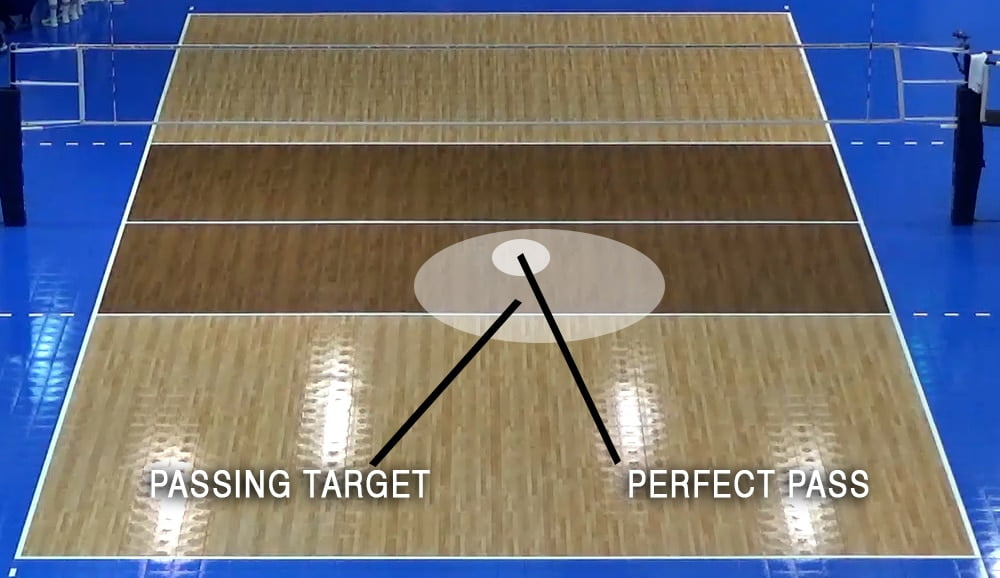
Regardless of your level, consider moving your passing target to around five feet off the net. The result: fewer overpasses, fewer tight passes, and significantly more good passes your athletes can turn into kills.
What Elite Teams Actually Look Like
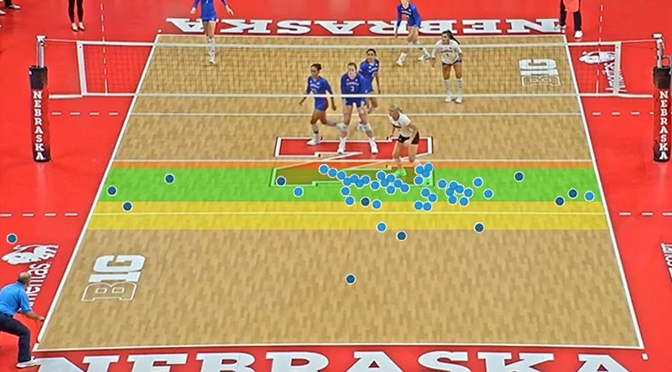
To see how this plays out in real matches, GMS charted 212 passes from the top four Big Ten teams in the first two rounds of the 2022 NCAA Tournament. A few things stood out immediately:
- Less than 2% of passes went over the net, only 4 out of 212
- Less than 1% were too tight to set, only 2 passes
- Just 6% of passes landed within two feet of the net
- The overwhelming majority clustered around five feet off the net
The heatmaps tell the full story, where each team's passes actually landed, color-coded by zone, with settable vs. non-settable passes marked. That full charting breakdown, including individual team maps for Wisconsin, Nebraska, Minnesota, and Ohio State, is inside GMS+.
See the Full Data - Free in GMS+
The full GMS+ guide includes everything from this article plus:
- All four Big Ten team heatmaps with individual pass stats
- Zone-by-zone breakdown of where passes landed and which were settable
- How to apply the five-foot target with your team in practice
- What the data shows about out-of-system passing at the elite level
- Coaching language for communicating the target clearly to passers of any age
Free to access. Create your GMS+ account and the full guide here.