BLOCKING IN VOLLEYBALL: TECHNIQUE, FOOTWORK, AND TEAM SYSTEMS
Everything a volleyball coach needs to know about building an effective block, from individual mechanics to team-wide systems.
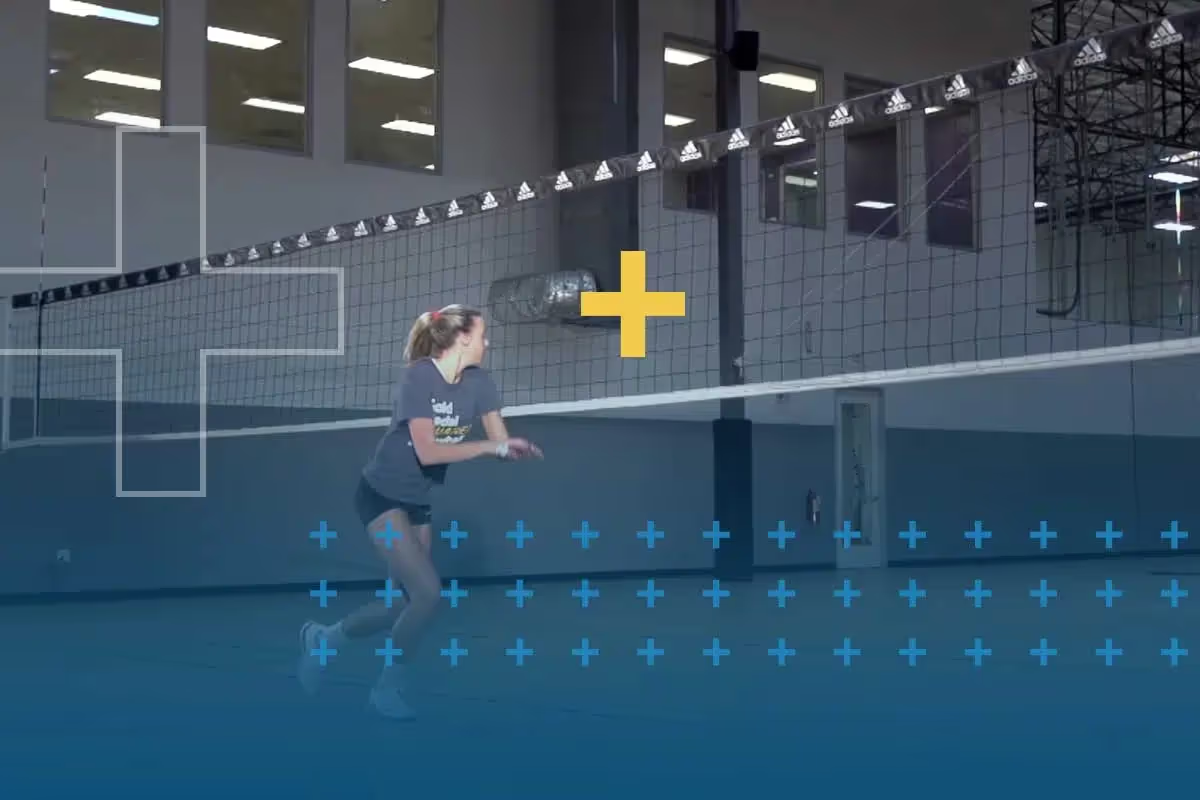
Blocking is one of the most complex skills in volleyball. It demands physical athleticism, disciplined footwork, precise timing, sharp eyes, and coordinated teamwork all executed in a fraction of a second. It also happens to be one of the most worked-on skills in the sport, and one of the most frequently taught incorrectly.
At Gold Medal Squared, we've been teaching blocking at every level of the game for over 40 years from junior high programs learning the basics to national teams preparing for international competition. This guide covers the full picture: the principles behind effective blocking, the individual technique and footwork your athletes need, the team system we've used successfully at every level, and the coaching traps that quietly undermine programs that are putting in the work.
Before Technique: Getting the Priority Right
The first thing to understand about blocking is where it fits in your program's priority order.
There's a strong relationship between the power of an attacking team and the impact of blocking. The higher the attack velocity and the more consistent the offensive execution, the more valuable a well-organized block becomes. At the other end of the spectrum, think early junior high teams or programs with developing serve-receive, blocking has less impact on match outcomes than passing and hitting do.
This matters for practice time allocation. If you're spending significant time on blocking but your passing efficiency is still developing, you may be investing in the wrong area. As your team matures and your opponents' offenses become more powerful and consistent, blocking becomes increasingly worth the investment.
The right approach: introduce blocking fundamentals early. Build the mechanics at a young age when the movements are easier to ingrain. But scale the time and emphasis you put into blocking relative to where your program is. Don't let perfect blocking become the enemy of good passing.
The Foundation: Four Principles That Drive Good Blocking
Before breaking down footwork and armwork, it helps to understand the principles behind what we're trying to accomplish. Everything in our blocking system flows from these four ideas.
1. Swing Blocking Produces Superior Results
The traditional blocking move (shuffling laterally with feet parallel to the net and hands raised) is slow, covers limited ground, and produces lower jump height than the alternative. Swing blocking, which involves opening the hips and using a dynamic crossover approach, allows blockers to move faster, jump higher, and get their hands further across the net.
This was historically a technique used primarily in men's volleyball. Over the past decade and a half, it has become standard across elite women's programs as well. Today, virtually all high-level teams at every gender use swing blocking as their primary blocking movement. If your program isn't there yet, this guide will give you the foundation to get there.
2. Hitters Hit Where the Set Takes Them
A blocker who reads the setter well can often predict where the ball is going before the hitter touches it. The set location is the most reliable predictor of where the attack will come from because hitters attack where the set puts them. This principle shapes how we train our blockers' eyes and when we want them making their decision to move.
3. Early Vision Drives Everything
If your blockers are watching the ball after the serve, then switching to the setter at the last moment, they're perpetually behind. Blockers need to get their eyes off the pass and onto the setter as early as possible. Then, from the setter, they track to the hitter. The earlier the vision, the more time to execute a good blocking move.
Eye discipline is the hardest thing to train in blocking, and here's why: you can't train eyes well if your athletes can't move well. A blocker who doesn't have solid footwork mechanics won't free up the mental bandwidth to focus on what they're seeing. Build the footwork first. The eyes follow.
4. Simplicity Creates Repeatability
The more complicated your blocking system, the more it breaks down under pressure. A blocker who knows two moves really well will outperform a blocker who knows six moves poorly. Teach fewer patterns. Train them deeply. In a high-stakes match, athletes revert to what is most ingrained, make sure what's ingrained is solid.
Individual Technique: Swing Blocking Mechanics
The Starting Position
One of the most underrated decisions in blocking is where your blockers start their hands. We prefer a hands-down starting position, hands relaxed near the waist, rather than hands raised above shoulder height.
Here's why this matters: when a blocker starts with hands high, they have to clear that elevated position before their arms can drop into the loading movement for the swing. That costs time. Starting hands-down creates a more compact, faster first move. The exception: if the opposing team passes exceptionally well and runs a consistent quick attack, hands up may be warranted because the reduced reaction time requires pre-loaded arm position.
3-Step Crossover Footwork: The Primary Pattern
The standard blocking footwork pattern we teach is the 3-step crossover, which applies directly to swing blocking. Each step has a specific job.
- Small first step with the lead leg - speed, not distance. The purpose of the first step is to initiate the move quickly, not to cover ground. Many elite swing blockers actually take a small negative step here, opening their hips toward where they're going.
- Big second step with the crossover leg - this is where ground is covered and momentum is built. The second step is the power step. Hands should swing low (near waist level) on this step, not high. Blockers who 'swim' their arms up above waist height on the second step are slower and less efficient.
- Third step squares to the hitter - as the blocker arrives at their destination, the third step begins rotating the body from a lateral open position back toward the hitter. This intermediate position before squaring fully to the net allows the blocker to carry momentum through the jump rather than stopping it.
- Square to the net at takeoff - at the point of contact, shoulders should be square to the net. This allows maximum reach across and over. With proper mechanics in steps 1–3, much of this rotation happens naturally through momentum.
The most common mistake: a big, slow first step. A big first step kills momentum and makes the whole move sluggish. Small first step. Big second step. This is the single most important mechanical correction for blockers learning the swing blocking move.
Armwork Keys
The armwork in swing blocking works in sequence with the footwork:
- Hands drop to waist level on the first step - compact, efficient, ready to load.
- Double arm lift on the second step - both arms swing together to generate upward momentum.
- Slight elbow bend at takeoff - this compact arm position helps blockers get their hands over the net faster. A straight-arm extension often results in a 'double move' - reaching up first, then over - which is too slow. One movement: straight over.
- Fast hands over the net, not up then over - being over the net matters more than being high. Train your blockers to reach with one continuous motion across the net, not up to the sky first.
The goal at contact is to get across the net with both hands together, fingers spread, reaching toward the attacker's court. Blockers who spread their hands apart or 'split block' create surfaces that are easy for hitters to tool off. Hands together, across and over.
Team System: The Bunch Read
Individual blocking mechanics matter, but blocking is fundamentally a team skill. How your three front-row players coordinate their positioning, movement, and decision-making determines how many sets your team can put two or three blockers in front of.
The system we've taught for years is the bunch read. It's been adopted by programs at every level and gender, including elite international teams. Here's why it works.
The Core Idea
In traditional blocking systems, pin blockers start wide and move inward. In the bunch read, all three blockers start closer to the middle of the court 'bunched' and make dynamic moves outward to the pin when the set dictates it.
The advantage: a blocker moving from the middle toward a pin attack is using a proactive, momentum-building move. A blocker who starts wide and needs to move toward the middle is working against their own positioning. Bunching creates better angles for every move.
Starting Spacing
Our default spacing guideline is 'elbows to elbows' on the left side and 'hands to hands' on the right. The right-side blocker starts a bit wider than the left because they're typically facing the opposing team's best attacker who gets set frequently and needs to be defended without a long move every time.
This spacing isn't fixed. It adjusts based on tactics, the opponent's tendencies, and the pass quality on a given rally.
Reading the Ball: Eyes and Timing
The bunch read lives and dies by eye discipline. The sequence we want:
- Get off the pass early - before the ball reaches the setter, blockers should already be watching the setter, not tracking the ball.
- Read the set for as long as possible - the set location tells you where the attack is coming from.
- Get to the hitter - ideally, blockers have transitioned their eyes to the hitter before or as they begin their jump.
Teams that run quick tempos force this read to happen faster. Against those teams, getting to the hitter earlier is necessary. Against slower tempos, blockers have more time and can ride the setter-read longer before committing.
The system works well when your athletes move the same way and see the same things. When some athletes have different mechanics and different eye habits, the team can't coordinate effectively. Consistency across your three blockers (footwork, eyes, timing) is more important than individual excellence.
Basic Tactics for High School and Club Teams
At the high school and club level, you don't need a deep tactical library. Two calls cover most situations effectively:
- Load - wing blockers drop their hands and begin preparing to run to the pin. Used when the opposing setter is likely to set a pin attacker and the wings don't need to defend the middle.
- Dedicate - a specific blocker takes a shuffle step toward a high-priority attacker (often a gap attacker that middle blockers step toward) while the ball is in the air on the pass, then immediately re-focuses on the setter for the read.
Commit blocks and trapping tactics exist, but for most high school and club programs, reading and reacting with sound mechanics and good eyes will outperform elaborate tactical schemes. Build the foundation first.
Common Coaching Traps
After watching programs develop their blocking, the same errors surface regularly. Knowing them in advance saves significant time.
- Arms 'swimming' above waist on the first step. This disrupts rhythm, slows the move, and is the single most common mechanical error in swing blocking.
- First step too big. Covers ground at the expense of speed. The first step should be small and quick. The second step covers ground.
- Second step too small. The reverse error - if the second step isn't big, blockers can't reach pin attacks from a bunched position. The second step is the power step.
- Squaring to the sideline instead of the hitter on the third step. This causes a longer, slower rotation arc back to the net and results in blockers being late or partially sideways at the jump.
- Double move with the hands. Reaching up, then over, is too slow. Train one continuous movement across the net.
- Split hands at contact. Hands apart give hitters too many tooling surfaces and reduce effective blocking area. Hands together, across the net.
- Drifting gets punished instead of encouraged. Blockers need to cover ground in the air after the jump. Coaches who overcorrect athletes for drifting train them to pull back - which limits blocking range. Allow and encourage purposeful drift.
- Unsupervised pre-practice reps. If athletes are running blocking warmups without a coach watching, they're cementing whatever habits they've developed - good or bad. Blocking mechanics require consistent supervised correction to ingrain correctly.
When to Introduce Swing Blocking
We recommend introducing the 3-step crossover and swing blocking fundamentals early. The mechanics are easier to learn before athletes have deeply ingrained a shuffle-based pattern - and getting the movement in the body at a younger age pays dividends as athletes grow stronger and blocking becomes more impactful.
That said, be proportional with your time investment. With younger or developing teams, passing and serve-receive should still command the bulk of your practice focus. Introduce the blocking mechanics, build the habits, and allocate more time to it as your team's level and your opponents' offensive power increases.
Go Deeper
This guide gives you the framework. For video breakdowns of swing blocking mechanics, the bunch read system in action, and drill sequences you can run immediately, GMS+ has detailed course content covering every element of what we've outlined here — taught by coaches who have implemented these systems at the highest levels of the sport.
Explore GMS+ Blocking Resources | View Upcoming Coaching Clinics
goldmedalsquared.com/gms-plus | goldmedalsquared.com/volleyball-clinics