10 Youth Practice Investments
For a lot of us, our youth volleyball career seems like light-years in the rear-view mirror. We have forgotten how bad we were when we were just starting, because who wants to remember that? We forgot how awkward and segmented our movements felt going for a ball or how embarrassing it was for serve after serve to skip off our dented platforms. The eye rolls of disappointed parents, coaches, and teammates that may have stunted your love for the game, or maybe lit the fire that still burns inside of you.
For others of us, we might recall fondly being a step ahead of the other players, showcasing our superior eye-hand coordination and movement skills in defense and the ability to crack a ball out of the back row with pace. Maybe being the coach’s favorite was because you had developed physically faster than your peers. Cheers, applause, and maybe even a few tournament wins dot your resume.
And still others of us were in the middle of these two extremes, good at some things, not good at others. Warm and cozy in our comfort zones, but urged by better coaches to leave them behind. Being pushed to self-doubt and discovery, but loving the camaraderie and the game itself so much that you stayed in it for a season of tomorrows.
Because these memories lie so far back in the recesses of our coaching minds, we sometimes struggle to understand the complexity of coaching a youth team. Here are a few ideas that might help level out the peaks and valleys of the volatile youth landscape, give your teams additional contacts, generate ideas, and help you coach our sports’ future.
The Machine
A blocked drill with a dash of random for beginning players in need of touches, the machine is a multi-functional, simple drill that focuses on ball control while keeping engagement high.
At its roots, half your team faces the other half, with one half on the baseline and the other at the attack line. Those at the attack line have a ball. On the coach’s whistle, the players with the ball toss to the players in front of them, who, in this instance, pass back to the tosser. Then every player shuffles to the right, except the player at the end of the line, who runs to the opposite sideline and gets the toss from the tosser in front of him. The players go around 4 or 5 times, getting 25-30 passing reps with movement in a 2–4-minute span. Then the whistle blows, the players switch, and we do it all over again.
We can work passing, overhead passing, setting, and passing short and deep (two tosses). We can incorporate net tossing over to a passer who passes to a target. If you have a large group, like the one in this video from the city of Beni Mellal in Morocco, where we had 50 10- to 12-year-old beginners who had never played before, we gave them instructions. In the span of 4 or 5 minutes, the passers got roughly 100 passing reps, with movement and variance. (Remember, every toss is different, and the players must read, move, and pass balls from different heights, speeds, angles, and distances.
The engagement is high because every player is busy. If balls are sprayed around the court, which is sure to happen at the beginner’s level, a coach with a full cart gives a ball quickly to the intended tosser to keep the machine moving.
Coaching Point- let them go. They will make mistakes, but there is a lot of learning happening. If you notice all the players are making the same errors repeatedly, make a mental (or physical) note on the whiteboard. In the next huddle, a demonstration of how to correct that error should be delivered. If it’s just one or two players, pull them aside for the correction, not the whole team.
If you are focusing on one thing, one key perhaps, watch one tosser’s line and “catch them doing it right” by giving a quick shout out. “Great platform, Ethel!
Meet Them Where They’re At
“Basic is sus when Coach gets skibidi with the practice drip and be delulu with the vibe. We just wanna eat, leave no crumbs, and show our aura farm is mega rizz, no cap.”
Engagement is the nucleus of the practice atom. Without it, coaches and players are wasting practice time, opportunities to get better, and the hefty court costs Parents pay for.
Coaching Point- If a drill isn’t working, stop. If you notice your players are spending time counting ceiling tiles while you are explaining the virtues of the 6-2 offense, stop! Get them back. Play their favorite game, a small-sided game, or scrimmage. Whatever it takes! Get their engagement back.
Sometimes, being WITH them culturally can be a huge engagement producer.
Their online slang, the recent Disney smash, the newest Netflix series that captivates 11-year-olds (thought my girls were losing it when they would get a kill and talk about K-Pop Demon Hunters… what?). Sometimes these fractional practice moments can be invaluable.
Yes, it’s okay to be the out-of-touch, old coach (guilty as charged) if the team finds it funny. Learning from your team is a wonderful exchange for both parties. And it’s super cool to be the young coach who knows exactly what a K-pop Demon Hunter does for a living. Using modern culture can be a strategic tool for engagement.
At one camp last summer, Doug’s Scramble became“Skibidi.” We would make teams, and we had the Aura team and the Sus team. During one scrimmage, if the team lost, they had to sing the song from the Disney movie, “Frozen.” Some games were played to the athlete-defined score of“6 7.” Camp engagement was high for the entire four days.
Coaching Point- These moments are part of the bigger idea- engagement. If it works, why stop? Ask the teams for suggestions, also known as autonomy. Humor is a wonderful way to break down walls and barriers. Have fun with it. Learn about what’s in the cultural zeitgeist for this summer and listen to and utilize what you pick up. Be wary of some words or movies that might be out of bounds. Ask younger coaches for help in that area if you are at the age when you expect to receive your Medicare statement.
Under-12s Start Attacking from the Back Row
For young players, the net can be a monolith of frustration and failure. Passes or sets are too tight, and for a young player who can walk under it without bending a knee, it’s an impossible recovery. When tennis players begin to learn the game, they usually don’t start at the net, despite being taller. They give themselves more time, more room to process the ball, and the ability to make the correct movement and play. The same is true in volleyball.
Let young players skip the tight rope walk and move them back behind the attack line. Teach attacking from the back row first and often. Add the idea of topspin to keep the challenge point, for those players who get the concept faster, something more to work on.
Using a ‘butterfly’ format, you can get lots of reps and add setting and defensive reps in this scheme:

The back-row attacker can toss a ball to the setter, bounce a ball to Stevenson, or toss a ball to the setter, who puts up a set at the attack line, helping the attacker know if they were behind the line or not. The defender reads the attack and, if possible, digs to themselves and catches the ball. Then they rotate by line: the attacker becomes the setter; the setter runs to defense, and the defender with the ball becomes the attacker. Usually, two attackers per line keeps the flow even and fast. Of course, if you are just working on the attack, keep it simple. Remove the defender and add a fourth attacking line.
Here is a video from several years ago showing adult players on the beach given a glimpse of what a young player sees when the ball closes in on the net. As you will see, the Adults did not fare particularly well.
https://www.youtube.com/watch?v=K8W0PtyPlD4
Coaching Point- Bolster your small court and 6 v 6 games by giving bonus points for back row kills. Can you add the bump set to this learning to be aware when younger players get bored because they are doing the same things repeatedly and not succeeding, as young teams spend most of their lives out of the system? A team that can attack from anywhere on the court has a significant edge against those teams with coaches tossing balls to hitters on the net.
The Chaos and Flux of Challenge Points
One of the many duties of a youth coach is awareness of when younger players are getting bored because they are doing the same things repeatedly, and being successful at those skills. A 10-year-old with nice hands will become unengaged in a basic setting drill every practice; they need/want to be challenged.
Coaching Point- If a player can repeat a skill or movement with a 65-75% success rate or above, it’s time to move the challenge point. But don’t be fooled by one drill or game. Watch them over a few practices. One good day doesn’t necessarily mean they have retained the information; it could just mean they are having a good day.
For this setter, maybe it’s time to start the net more to incorporate movement and track the pass while the rest of the team, still beginners to the skill, need a toss right to them to help them succeed at this challenge point.
The difficulty is that your players are all different. Some will learn skills faster than others, and some slower; as a Coach, you need to find the appropriate challenge point for both, often in the same drill.
This will be a coaching commodity for the rest of your career, no matter what the age groups, but the titanic variance in skill levels in the Youth game makes this a bit more challenging. Having an Assistant Coach who can help with a stronger or weaker player group can keep practices efficient and engaging.
Coaching Point: Keep these Challenge Point activities at the learner's level. Beginners might need blocked activities, and if you can, sprinkled with randomness. Better players should be using the net and involved with multiple players, variance, and problem-solving in their Challenge Point activities.
The Kessel T
Coaching Point- I would urge all of you to track down and watch/listen/read as much as you can from USAVolleyball Sage and Wisdom Coach John Kessel. JK has been in this space since the Nixon administration and has given ideas, confidence, and advice to more coaches around the world than you could count. He is still active and is still presenting scientific clad arguments to volleyball countries and programs with a fraction of the resources most of us enjoy. He has worked with GMS and was the impetus behind our Youth Manual in your GMS camp manuals. Listen and learn at your leisure as he appears on podcasts, maintains a large YouTube presence, and has writings across the blogosphere.
Some years ago, Kessel gave us an idea we used, but for some reason, we rarely see it anymore. Since more coaches are being forced to half-court training, it was time to bring this gem back.
Tie a ribbon or rope onto a plastic hook or carabiner. The rope or ribbon should be approximately 32-34 feet long. You can attach the hook or carabiner to the middle of your side of the net, then run the rope or ribbon back to the service line, held up by a Coach or involved Parent. Your team has a dandy mini court to warm up on and over for those 5 minutes before matches start or the time between matches, when limited to one court.
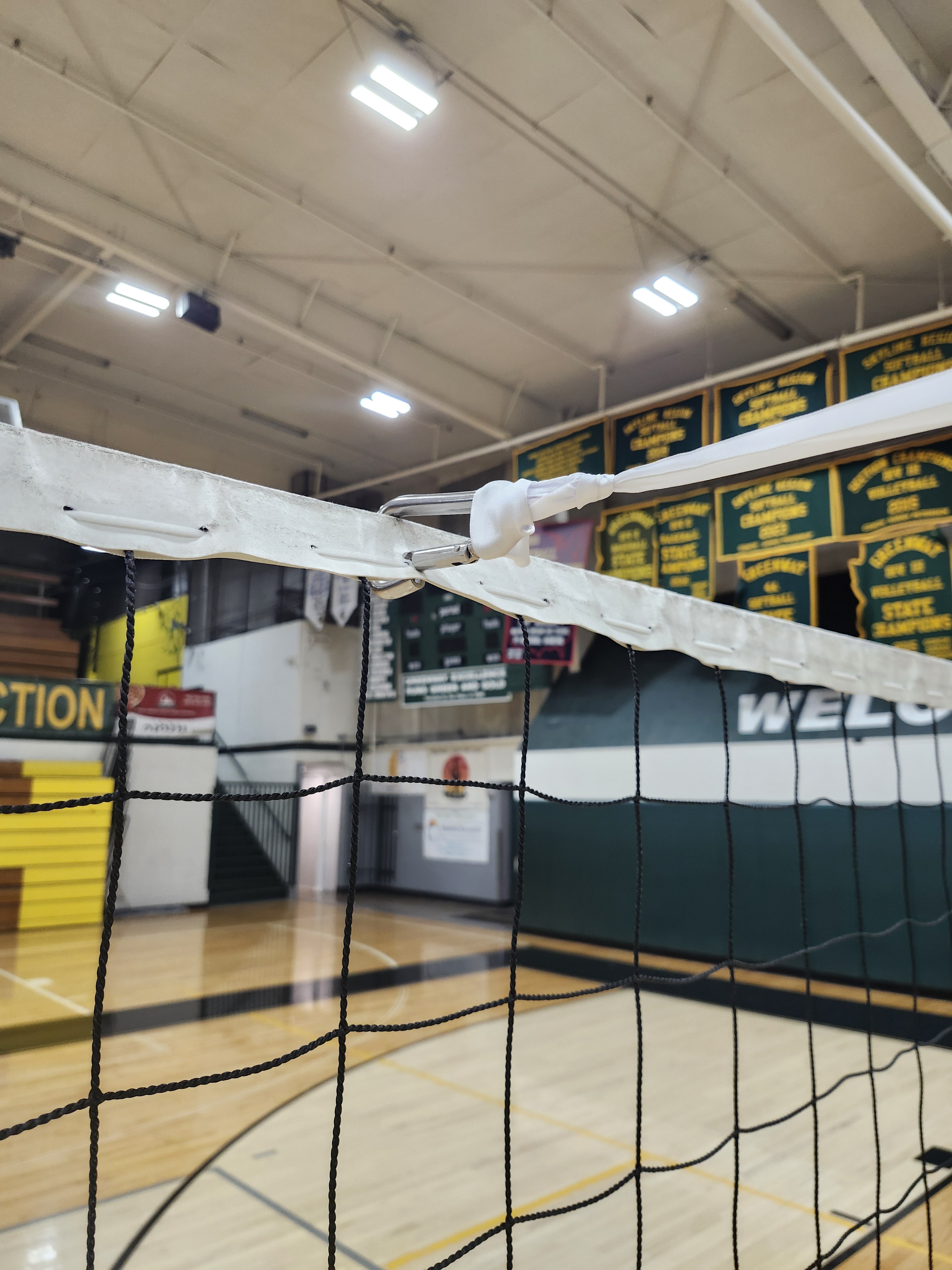
One v. one, 2 v. 2 or 3 v. 3 games can build all skills, reading, a sense of the court’s lighting and size limitations and most of all, FUN into what is often a dreary 5 minutes or more of pepper or coach hitting to one player at a time, which devours engagement with each trip to the end of a line.
If a team Mom owns a glue gun, and using a thick ribbon, divide the number of players you have by 360 inches. For example, 12 players would be 30 inches each. Divide the ribbon into 30” sections and, as a fun activity, let the players use markers to write their name and decorate their space on the ribbon. When the season is over, it’s a nice keepsake for the coach.

Some of you will question the legality of the Kessel T. According to the Arizona Region Official’s Chair, “There is not rule or limitations to what a team can do during their warmup. So, bydefault legal.”
Inexpensive, light, and small enough to fit in a ball cart pocket, this is a nice tool to have on hand. Try it at the next tournament or during half-court practice.
Stop Running and Stretching for Warmups
The afore mentioned Kessel has been talking about this idea for 45 years. FORTY-FIVE YEARS! His patience on this one subject could put a mountain Yogi to shame.
Path dependency is a term describing the idea of ‘how we were coached is how we will coach.’ If your last coach was a disciplinarian and a yeller, there is a good chance this will describe your coaching style as well. If they used science and did drills and games that were engaging and steeped in Motor Learning, chances are your practice will reflect that.
and stretching for warm-up goRunningand stretching for warmup goes back to Greek and Roman civilizations. I’m no historian, but I doubt a Mikasa V200 was sitting around the Coliseum for a rethink of the idea.
Chances are, your young athletes already know how to run. They may not be fast or have great form, but they can run. And after sitting in a classroom for four hours and then being unleashed onto the playground, you don’t see too many students stopping to stretch and limber up before heading to the slide or the basketball courts.
Also, let’s avail ourselves of the notion that it’s necessary for youth players. In a 2012 meta study by Kay and Blazevich titled “Effect of Acute Static Stretch on Maximal Muscle Performance: A systematic Review”, the results showed that stretching had “no significant effects” and even worse, “stretching before competition or working out impairs performance.” Other studies on stretching for injury prevention show not only that it doesn’t help but might actually increase injury risk.” Even the FIVB, in their newest coaching course, denounces static stretching as a precursor to practice.
Yes, dynamic stretching has more merit, but these are youth players. Do they need to do more carioca in their lives or touch more volleyballs? A simple question to ask: how can I get my players to touch a ball first thing in practice? I guess they could do carioca while passing to themselves, which would deliver dynamic stretching with ball handling, but those movements aren’t going to come up a lot in sports.
How about we play? Small-sided games, speedball, Monopoly of the Court, mini-tournaments, etc. WAY more engaging, competitive, game-like, and FUN. Can we use constraints to hone in on the focus of our practice today, using the warmup as an introduction to that skill or movement? Can we get them to start figuring out how to solve the problems they will face in practice before they start?
Running and stretching for 10 minutes in a season will cost you roughly six and a half hours of practice time. Three to four full practices or more. The cost of the gym for 3 or 4 more practices, the opportunities lost for hundreds of contacts, hundreds of opportunities to read, and hundreds of problems to solve. Is that 10minutes of butt kicks and carioca worth it?
It’s such a small change. Tomorrow’s practice, call the team together and play 3 v 3 on a split court. After 3 minutes, keep one team on their court and rotate the other three. After three more minutes, rotate them again, and finally, a last rotation. In those 12 minutes, count the contacts in the context of the game, and see which is more beneficial for your players.
Coaching Point- No one likes change. Those who heard Kessel forty-five years ago, who still run and stretch, may never change. But it’s disingenuous to ask your players to constantly evolve if you, as their coach, refuses to.
Creating a Culture of Play
When your team comes into the gym, do they sit and talk and put their shoes on slowly? Do they sit with their Parent until they blow the whistle? Do they show up 90 seconds before practice is scheduled to start?
These are lost opportunities.
Put the balls out, make sure the net is up, and encourage the players to get there early to…play! (If it’s not possible to have the net up before they arrive, teach them “Be the Net” and how to play off the wall). Onev. one with a friend or a coach, 2 v 2. Pass or set into basketball hoops, the first one to score five from a bounce wins.
The power of play is real. At a coaching clinic a few weeks ago, being held on a Sunday morning, several of the 25 or so coaches had played in a pool, a two-hour drive away, the night before. They were tired, cranky, and did not want to be there.
So, we played.
We taught them Be the Net and then played some long, skinny half-court, short-court, pass-only, monarch. We made the court bigger and continued with Monarch. We used the whole half court and played a tournament with teams of 4 and 5. We played cross-court. We played with constraints in different games: we played Don’t Drop the Baby, we played that you could only attack with your off hand, we played 2-touch v. 4-touch, and switched. We played Follow the Leader and 3-2-1. And after this first hour, the coaches stood in a circle, laughing, smiling, talking mad smack, breathing hard, but so engaged and ready for the classroom session ahead. The power of play had brought them out of their funk; they remembered why they loved this game, and what it’s like to have fun.
Could you make the court available for your players who show up early? Those who are on a 90-second buffer might show up to play earlier. Let them decide the game, where, and what they will play to. Teach them, then let them decide which constraints they would like to incorporate into their drills.
If the playing level is high and the engagement is stellar, let them bleed into the beginning of practice. That’s what we are planning and searching for anyway, isn’t it?
While this is traditionally less of a problem for boys, who will take whatever equipment they find and make a game of it, girls are less inclined to do so. So, give them the green light. Encourage them to play. Create the culture that engages everyone—a culture of fun, a culture of play.
Coaches Point- If any of the above games aren’t familiar to you, just shoot me a note, and we can explain. But don’t rely on what you read on the GMS site. What constraints and conditions can you put into a small-sided game that will engage your players? There is only the limit of a coach’s imagination for creating new games, constraints, scoring methods, court sizes, and boundaries, etc.
Have the Talk!
If you are reading this on the GMS platform, it is expected that you are no longer conducting a one-ball, one-player, toss-and-shag training. Perhaps you have embraced Ecological Dynamics as a coaching framework, or you have honed your Internal Processing practices to an efficient set of drills and games.
But Parents' expectations are often based on social media posts, Hollywood depictions of coaching, or how their last coach did things.
Ecological Dynamics guru Rob Gray often talks about how, when he coached his son’s youth team, his parents would complain because he wasn’t coaching. He was, of course, letting the athletes figure things out within the constraints he had given them, but to Parents it looked like a free ride at the club’s expense and parental dues.
So have the tal. Explain to Parents why you are doing what you do. Your coaching philosophy, how your training might look different than their last coach, or their perception of what they think coaching should look like. Explain how too much explanation can be counterproductive to an athlete's growth. Explain to them how you are coaching them, and then a parent coaching their athlete is detrimental to the player’s retention and transfer. Explain to them that running and stretching are costing them money and their players' contact with the ball.
One study of club sports in general suggests that 80% of parents did not know recommended training guidelines, indicating parents often don’t have detailed technical knowledge of sport rules or strategy. Eight out of ten! Chances are great that you will be teaching more than informing or defending your training.
So, enlighten them. Help them understand why you coach the way you coach. Promise them you will make mistakes, like every coach, like every player, and often, every parent as well, and that we should all be showing each other the grace due members of our team, which parents certainly are.
One proactive idea is called “Parents as Partners.” Set aside 4 to 5 practices at the beginning of the season. Ask parents to sign up for which practice they would like to assist with. (Usually no more than 2 sets of parents at one practice). The caveats are as follows: the parent cannot disrupt the practice in any way; they cannot pull their young athlete aside for any reason; and they must be positive with every athlete. (Be blunt and ask directly if a parent is going to have problems with these rules; they should disqualify themselves and not participate.)
During the PiP practice, the athletes are introduced to the parent(s) and vice versa; the parents are also in the huddles, listening to how you talk to the team. They can help toss balls if needed, help shag, or, if they still play, maybe be part of some drills. After practice is over, set aside 10-15 minutes to answer questions about the drills, the games, the overall practice, and the whys, whats, and hows that will be asked. This transparency not only puts new parents at ease, but it also helps the player-coach-parent triumvirate become more unified on our season goals for both the team and their athlete.
Coaching Point- Think about how you treat your team's parents. Are they a pariah to be avoided at all costs? Do you greet them when you walk into practice or blow by them as if you don’t have time for them? How you treat your parents will get the returns you deserve. Embrace them. Yes, they can be peevish and unreasonable at times, but communicate with them often. Once a week is not too much. Explain what we did in practices this week, and how the parents can help their athlete retain what we hope they learned this past week. Give them the schedule for next week. Give them the tournament information as soon as it’s available. A cranky parent is often one who is embarrassed because they were caught off guard by something-a practice change, a line-up excluding their child, a court switch, etc. Many of you are sports parents. What makes you peevish?
Emphasizing W’s is an L
Youth sports are the only space in existence where expectations are to win when you don’t even know how to play. Imagine going into your job at Intel, and you are told, “We need the fastest computer chip in the world by next Tuesday, and here’s a book that will help- ‘A Dummy’s Guide to Computers.’ Have at it!”
The absurdity of that statement should resonate with coaches and parents alike. We have a handful of weeks to teach skills, rotations, positions, strategies, and teamwork to a group of young players who might still be fretting over the nuances of tying their shoes.
Let’s be clear. Youth sports are supposed to be for development. The physical, psychological, and physiological aspects are all present in the youth sport arena.
And yet parents, coaches, and soon the players themselves begin to gauge their success on wins and losses. Quickly, who won the Northeast Qualifier’s Club division last year? This year? Anyone? While it’s an achievement for sure, it’s not what we should be focusing on.
For beginners, maybe the number of three-hit possessions they have in this match is what we are shooting for. Maybe it’s more subtle: on court body language and the idea of team over me. How can an athlete learn to embrace failure if the only metric they hear is binary- success or failure, wins and losses? What is the impetus to grow if that’s the only two categories your sporting life is graded on?
One of America’s most beloved, quoted, and admired coaches was UCLA men’s basketball coach John Wooden. After countless National Championships and accolades, a secret came out that stunned many. He believed, "My bench never heard me mention winning. My whole emphasis was for each one of my players to try to learn to execute the fundamentals to the best of their ability".
Coaches who teach their teams to send the ball overhanded have this mentality. Coaches who leave substandard players on the bench for an entire tournament have this mentality. Parents who post the results of a match where only serves and missed serves score points have this mentality. Where is the learning? Where is the skill and movement training? Where is the problem-solving?
As with everything in this article, there are exceptions. Sometimes teams are put together that have a few competitors, and even at the youth level, show a strong will to win. We never want to stunt this mentality; we just don’t need to glorify it at the expense of the rest of the team.
Coach Point- What’s important to you is probably not as important to your youth squad. Moving up to the next division may be at the top of your priority list this tournament, but#9 just wants to play so her parents can watch. Number #16 just wants to get her new overhand serve over One of your setters, 22, wants to try just one back set, a skill she tried for the first time this week in practice Wins and losses often reflect the coach's and parents' values, not our athletes For Parents, wins and losses are the only touchstone they have experience with if they know nothing about the game
Stop our Obsession with “Call the Ball.”
This is a classic case of not remembering when you were just learning the sport. You probably did not call the ball in your first practices in live scrimmages, and there is a reason for that.
You didn’t have enough spare attentional capacity or “an open bedroom in your attic” to utter anything.
Using peer-reviewed science, let’s look at the senses a young athlete uses as they begin skills and movements in their sport of choice. In order, they are:
1. Vision
2. Proprioception (body awareness)
3. Touch (tactile feedback)
4. Hearing
5. Vestibular sense (balance and movement of the head)
Calling the ball comes much later in an athlete’s development. Young brains are focused on seeing the ball, judging its flight and speed, moving their body, and finally executing their movement or contact. Communicating “mine” is well layered behind the perception and action of the skill being learned, because calling the ball is not a core perceptual skill.
Athletes will start to communicate with teammates when they gain confidence in ball judgement, an awareness of their teammates, and a social and tactical understanding of whose ball it is. Early learners are cognitively overloaded and are just trying to (A) not get hit and (B) make contact with the ball. There is no bandwidth in this scenario for talking. It takes time. It takes enough spare attentional space in their brains to know what to say and when to say it.
Parents parrot coaches screaming at 10-year-olds who are just trying to survive at the beginning; CALL THE BALL!!! Coaches tend to unleash the hounds of hell if a ball drops with no one saying “mine,” but often, coaches, too, with so much on their minds, forget to tell a player something or give feedback. Bandwidth is affected by emotion, stress, and what you are currently perceiving.
So please, Mom, Dad, Coach…. Let’s give the youngsters a break. Once they become comfortable with passing, serving, and receiving, they will start calling the ball. If, as a coach, you think this is causing you to lose matches, you have your priorities misplaced.
Coaching Point- How many of your athletes are making mistakes on purpose? I saw a post from a coach of 11-year-olds making her team run around the court with the volleyball over their heads, shouting “mine, mine, mine” constantly through every lap. This egodriven coach isn’t looking in the right place. She is deficient in motor learning science and feels punishment outweighs progress. When athletes make mistakes, as a coach, first ask why? Why did we have balls drop? Is it that these 10-year-olds didn’t call the ball, or could it be that they're still unsure whose ball it is? OR could it be that there are too few passers in serve-receive, given the players' level? OR is it possible that these 10-year-old girls have never seen a serve that hard and fast before? Be a good detective and understand that often, it is a hole in your coaching, explanation, or feedback that needs to be addressed. Young athletes want to succeed and make their coach, parents, and teammates proud. So please help them!