The Importance of Good Transition Footwork in Volleyball
Transition offense is where most volleyball matches are actually decided and it's the phase of the game most teams underinvest in.
The reason is simple: it's ugly. Transition situations are chaotic, inconsistent, and hard to practice cleanly. So coaches default to first-ball offense and hope for the best once the rally goes more than two contacts.
The data says that's a significant mistake.
More Than Half of Your Offense Happens in Transition
GMS analyzed data from all ten West Coast Conference women's volleyball teams in 2019, breaking down every attack attempt by phase of play. The results were clear:
All attacks:
- First ball (attack immediately after serve receive) = 47%
- Transition = 53%
In-system attacks (after a good pass or dig):
- First ball = 54%
- Transition = 46%
Out-of-system attacks (after a bad pass or dig):
- First ball = 36%
- Transition = 64%
More than half of all offensive opportunities , and nearly two-thirds of out-of-system situations , happen in transition. If your attackers aren't trained to be available and on time in those moments, you're conceding points your offense should be winning.

Where Transition Attacks Come From
Outside hitters dominate transition attack volume. WCC data from 2019 shows that in transition, left-side attackers account for 58% of all attempts , more than middles and opposites combined.
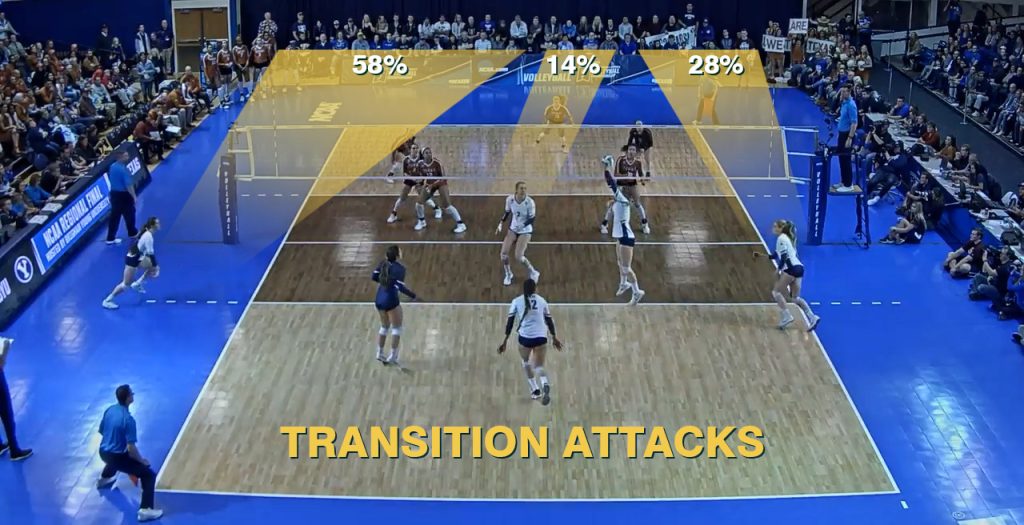
That number creates two coaching priorities:
- Outside hitters must be trained specifically for transition , they'll get more attempts than anyone else, and efficiency there wins matches.
- Middles and opposites must make themselves available , if setters only have one attacker to work with in transition, defenses adjust quickly.
For all three positions, the answer is the same: repeatable footwork patterns that get players off the net, turned, and back on approach in time to be a real offensive threat.
What Good Transition Footwork Actually Does
Transition footwork isn't just about getting to the right spot. It serves three functions that compound over the course of a match:
- Reduces fatigue , efficient patterns mean less wasted movement over 5 sets
- Improves timing , repeatable footwork means consistent approach rhythm, which produces consistent contact
- Creates options for the setter , when all three front-row players are available in transition, opposing defenses have to account for all of them
The footwork patterns differ by position and by starting situation , whether the player is blocking left, blocking middle, blocking right, or defending off the net. Each scenario has a specific pattern that gets the athlete off and back efficiently.
The Full Footwork Guide Is Inside GMS+
The data above tells you why transition footwork matters. The full paid guide covers exactly how to teach it , position by position, situation by situation, with GIF demonstrations for each pattern:
Left Side Attacker:
- Block left + 4 off + 4 on
- Block middle + 4 off + 4 on
- Off-blocker defense + 4 off + 4 on
Middle Attacker:
- Block left + 3 off + 3 on
- Block middle + 3 off + 3 on
- Block right + 3 off + 4 on
Opposite (Right-Handed):
- Block right + 3 off + 4 on
- Block middle + 3 off + 4 on
- Off-blocker defense + 3 off + 4 on
Opposite (Left-Handed):
- Block right + 4 off + 4 on
- Block middle + 4 off + 4 on
- Off-blocker defense + 4 off + 4 on
Each pattern includes step-by-step coaching notes and GIF demonstrations. Available here with a GMS+ paid membership.