6-2 VOLLEYBALL ROTATIONS - A COMPLETE GUIDE
The 6–2 volleyball rotation, often called the 6–2 offense, is a system designed to maximize a team’s attacking options and strengthen the offensive lineup. At Gold Medal Squared, we believe offensive systems should be tailored to the players on the roster, and that strong coaching principles help guide smart decisions about who plays where.
Want to see exactly how each variation looks in action? GMS+ has video breakdowns of all three — start your free trial here and watch them today.
Article Summary:
- What exactly is a 6-2 system?
- 6-2 with no substitutions
- 6-2 with one substitution
- 6-2 with two substitutions
- The pros and cons of each 6-2 variation
- Which variation is right for your team?
What is a 6-2 system in volleyball?
To start, let’s break down what the numbers 6–2 actually mean. Volleyball offensive systems are named based on the number of hitters and setters on the court. For example, a 6–2 rotation includes six hitters and two setters.
- 2 players that set
- 6 players available to spike
As another example, a 5-1 system would include.
- 1 dedicated setter
- 5 players available to spike.
What makes the 6-2 volleyball rotation unique is that it allows for three primary variations depending on the abilities of your athletes.
- 6-2 Volleyball Rotations with 0 Substitutions
- 6-2 Volleyball Rotations with 1 Substitution
- 6-2 Volleyball Rotations with 2 Substitutions
For a better visual, we have provided you with a 6-2 volleyball rotations PDF or cheat sheet below. Feel free to download this Free PDF and use it however you’d like.
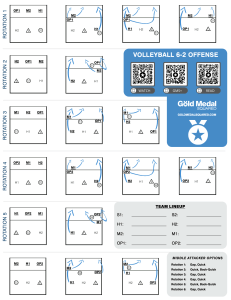
6-2 volleyball rotation pdf / cheat sheet
6-2 Volleyball rotations with no subs
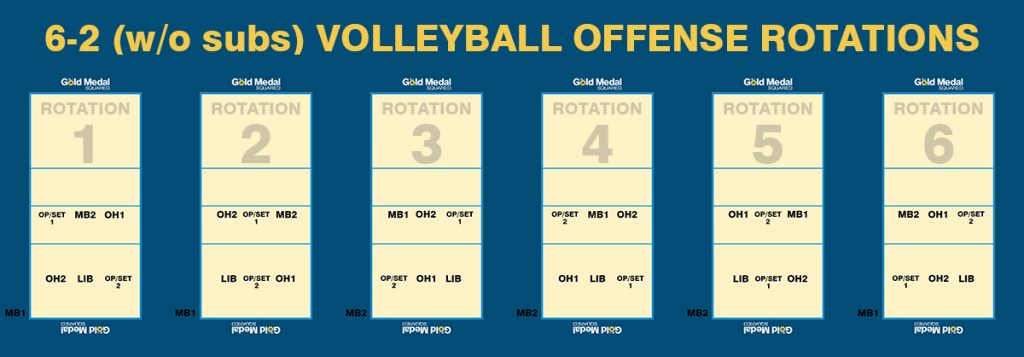
The 6–2 offensive system without substitutions requires two athletes who can both set well and attack effectively. Instead of using one designated setter, this variation features two hybrid setter/opposites on the court at the same time. Depending on whether they are in the front row or back row, their role changes.
When they are in the front row, they play as a right-side attacker. When they are in the back row, they act as the setter. Finding athletes who are strong in both skills isn’t easy, but some teams are able to make it work.
Below is a GMS+ video illustrating how the 6–2 rotation without substitutions works.
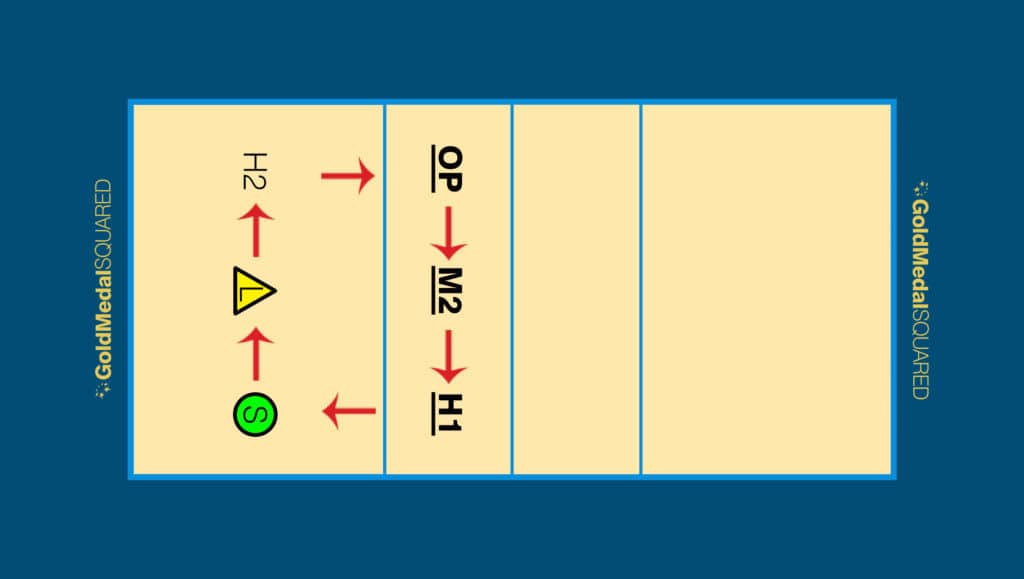
As the right-side defender in Position 1 rotates into the front row, they become the front-row right-side attacker. When that attacker rotates back to serve, they become the new setter for the three rotations they remain in the back row.
6-2 WITH NO SUBS - KEY POINTS
- The right-back defender will always set.
- The right-front attacker will always hit.
- Middles and outsides will continue in their roles as normal.
- You do not need to use any substitutions.
- You will always have three front-row attackers.
ADVANTAGES
Like all 6-2 variations, the primary benefit is having three front-row attackers at all times. When you're running this variation, with two hybrid players, in theory, you should have some consistency with those six players on the court throughout. You remove the variability of subbing in additional athletes.
DISADVANTAGES
As the name suggests, you aren't making as many substitutions as you do with the other two variations. This can also be a con, particularly in the world of club volleyball where playing time is important.
Next, it's very rare to have two really good hybrid players. Often times coaches will opt for a 6-2 because of the playing time benefits without knowing if one of the hybrid players is helping or hurting the team in certain rotations.
6-2 VOLLEYBALL ROTATIONS WITH ONE SUBSTITUTION
The 6–2 offense with one substitution allows a coach to give players more specific roles on the court. This system gives the coach the opportunity to use one athlete as a strong front-row attacker while also relying on a consistent back-row setter.
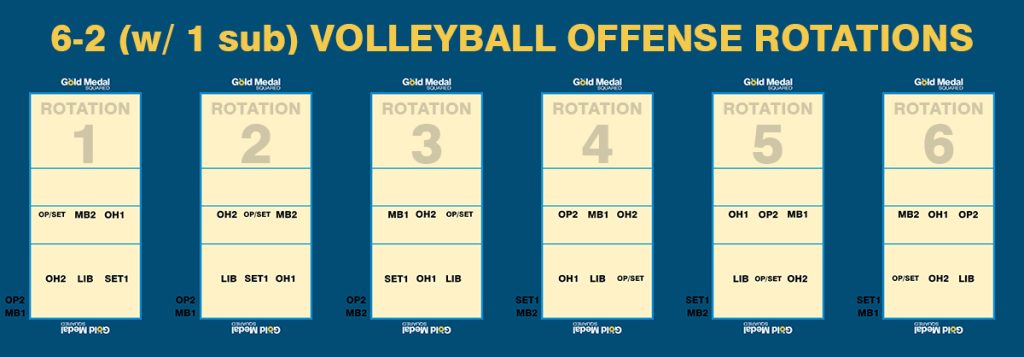
As shown in the GMS+ video below, the system starts with the setter in the back row and the hybrid player in the front row. The setter runs the offense from the back court, while the hybrid player attacks as the front-row opposite. After three rotations, the setter rotates into the front row. At that point, an opposite hitter is substituted into the match for the front-row setter. At the same time, the hybrid player rotates into the back row and becomes the team’s setter for the next three rotations. After three more rotations—when the opposite moves into the back row—the substitution is reversed.
6-2 WITH ONE SUBSTITUTION - KEY POINTS
- 1 setter/opposite hybrid player
- 1 back row setter
- 1 front row opposite
ADVANTAGES
If a team has a strong setter who is not suited to playing in the front row, the 1 sub option gives that player a role (especially if she’s a really good setter).
As with other 6-2 volleyball rotations, this system also gives your team three front-row attackers at all times (a bonus).
Next, the opposite position is typically utilized for a power hitter. Ideally, this hitter should have the ability to hit in-system, and terminate sets out of system (especially in men’s volleyball). Having such a player for 3 rotations across the front row is a clear benefit.
Having a good opposite can also provide an opportunity to redefine the roles of other players within the team: for example, if you have a middle who blocks well but struggles offensively, you can allow them to focus more on the blocking aspect of their game while your pin attackers can carry the load offensively.
Another skill that this system allows for is when a team’s opposite is a strong server. The opposite can stay on the court for the extra rotation to serve when in position 1 without the team having to make an extra substitution. The hybrid player in position 4 would be able to play as the setter for that one rotation. The team now has a strong serving option that potentially wins points and the opposite can provide an extra back row attack option after serving (think transition).
DISADVANTAGES
Setter-hitter connections play an important role in offensive success. If a setter and hitter are unable to connect, frustration can build in both players and communication can tail off, resulting in a lack of trust within an important part of the team’s system.
In a system that uses two different setters, it’s possible to set up the rotations pairing attackers and setters who have good connections. Note, there will always be one rotation when the attackers will have to play with the second setter.
In a tight game situation this could cost a team more points than they gain if they are unable to break out of a serve receive rotation.
The success of the system could also come down to practice repetitions. A hybrid player could be a great attacker and have good hands, but it takes a player with a good volleyball IQ to run the offense.
For most high-level teams, this system is rarely used. Finding a hybrid player that checks all of the boxes is a challenge.
WHO SHOULD USE THIS SYSTEM?
- Teams with a versatile player that would be a good attacker and good setter
- Teams with limited substitutions but no opportunity for two hybrid players.
- Teams with players preferring different setters.
- Teams with an attacking weakness in either a middle blocker or outside hitter.
6-2 VOLLEYBALL ROTATION WITH TWO SUBS
The 6-2 with subs variation is the most common in today's game.
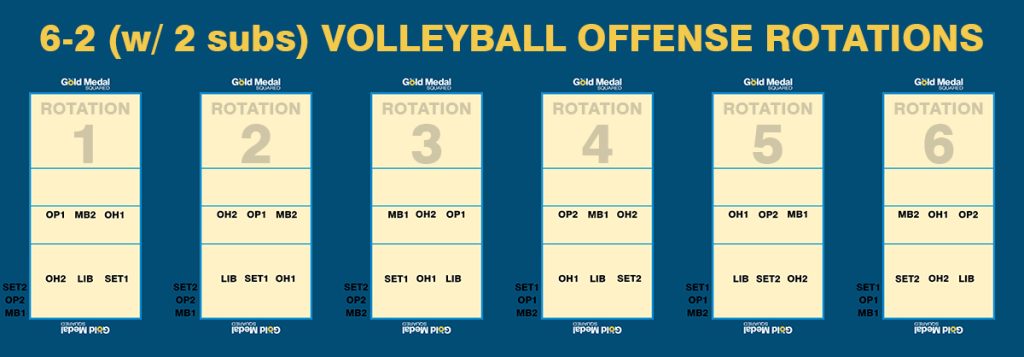
What is the 6–2 volleyball rotation with two substitutions? In this variation of the 6–2, the right-side players are given very specific roles. The system requires four right-side athletes:
- 2 setters (S1 and S2)
- 2 opposites (OP1 and OP2)
This setup allows a coach to use two strong setters and two high-level right-side attackers. It also ensures there are always three front-row attackers available throughout the match.
As shown in the GMS+ video below, the system begins with setter S1 starting in the back row and opposite OP1 starting in the front row, while S2 and OP2 are off the court. S1 runs the offense from the back row, and OP1 attacks as the front-row right-side hitter.
After three rotations, S1 rotates into the front row and OP1 rotates back to the serving position. At that point, two substitutions are made: S2 enters to replace OP1, and OP2 enters to replace S1. Now S2 becomes the setter, and OP2 is the front-row right-side attacker—maintaining three front-row hitters.
After three more rotations, when OP2 rotates into the back row, the substitutions are reversed. This pattern continues for the duration of the set, as long as the team does not exceed the maximum number of substitutions allowed.
ADVANTAGES
Players can commit to specific roles within the team, which allows them to focus on developing the skill set required for that position. The team will also have a dedicated, strong right-side attacker and blocker in the front row for all six rotations. This helps setters distribute the ball more effectively and creates problems for opposing blockers and defenders.
The 6–2 rotation with substitutions also gets more athletes onto the court, and playing time is valuable for long-term player development. In addition, this system can help teams build stronger connections between specific setters and hitters.
Advantages summary:
- All players have specialized roles and positions.
- A strong right-side attacker and blocker is in the front row at all times.
- The offense can always set to three front-row attackers, creating a more balanced attack.
- Setters do not have to block or play in the front row.
- More athletes can gain meaningful playing time during matches.
- Teams can establish stronger connections between specific setters and opposites.
DISADVANTAGES
When setters are constantly coming in and out of a lineup, how does this affect the team’s rhythm? Is your team struggling to stay focused and connected with all the changes that are taking place around them?
Similarly, how are the setters and opposites affected by constantly coming into and out of the game? They play for three rotations, sit for three rotations, then return to court.
Another potential problem could be that although opposite players will have the same setter for their 3 front court rotations, the other attackers (middle and left side) will have a mix of both setters. They will need to form connections with two setters, which is not an easy task.
IMPORTANT - MAKE SURE YOU DON’T HAVE A LARGE EFFECTIVENESS GAP BETWEEN BOTH SETTERS. THIS WOULD LIKELY RULE OUT THIS SYSTEM FOR YOUR TEAM.
In rotations 1 and 4, the standard serve-receive formation has the outside hitter hitting on the right, and the opposite hitting on the left (learn more about set names here). This system requires your outside hitter to hit on the right in 33% of your serve-receive formations. For some teams, this would be considered a disadvantage.
On many teams, the setter plays a vital role in leading the team. They are the link between the defense/serve reception unit and the offense. They have to understand the game plan of the coach and be able to execute it.
If setters are switching in and out of the game are they still able to lead the team effectively?
With this system, the opposite player will not be given the opportunity to serve. By not your opposite to serve, you might be missing a chance to put pressure on your opponents.
Note, if you do have a strong serving opposite, you can allow him/her to serve while keeping the setter (the player across from the opposite) in the front row while this opposite serves.
One other important consideration when thinking about adopting this system (particularly with younger players) is the question of ‘Too Early Specialization’.
If players are assigned specialist roles early on in their careers then they risk not fully developing as ‘all-round’ volleyball players.
While specialization may be desirable at the top end of the sport, it is more important for those athletes in the formative years of their volleyball careers to learn how to perform each skill.
Disadvantages summary:
- Middle blockers & outside attackers need to form more than one setter-attacker connection.
- Setting rhythm and momentum can change after substitutions occur.
- If the setter is a leader on the court, is team momentum affected by substituting them off?
- Opposites do not typically serve – are you missing a potential weapon?
- Risk of players not developing an ‘all-round’ understanding of the game.
WHO SHOULD USE THIS SYSTEM?
For a squad with great depth, this system provides an opportunity for coaches to use the abilities of their athletes. If a squad has 2 strong opposites who really struggle with the defensive aspect of the game, they can focus on their strengths (attack/block) and worry less about the defensive side of their game. If they are capable of attacking a variety of different balls or have different dominant hands, they are also adding in more variables to the team’s offense which gives the opposition more problems to deal with.
This System only works for teams who play in competitions that permit a large number of substitutions (such as high school volleyball, US Junior Club volleyball, and NCAA women's volleyball) where teams have the ability to reverse the substitutions multiple times in a set.
For teams playing under FIVB international rules (such as the NCAA men’s competition), a maximum of six substitutions per set is allowed so it would not be possible to reverse these substitutions more than once in a set.
In the NCAA men’s game (and other competition under FIVB rules), this ‘substitution + reverse substitution’ play can be used for a short term momentum swing but in this case, it isn’t a true ‘6-2 with 2 substitutions’ system.
If a team is trailing in a set, with both scores in the 20’s, and their opposite player is backcourt, then it might make sense to make this move if they have another strong opposite and setter on the bench to increase the front row attacking options. This will likely result in a stronger block, and the setter will be able to spread the offense more effectively (in theory). In a game of narrow margins, this might just swing a game in your team’s favor.
If a team with a front-row setter does not use the slide attack effectively (or at all), or the opposition is not honoring the slide, then it might be effective to have 3 front row attackers instead. Even if the front-row opposite doesn’t get set as much as the outside attackers, having three attackers in the front row increases the number of possible attack options that the opposition block will have to consider.
For many junior clubs, this system is effective as it offers the ability to give more players on the roster game opportunities. However, as mentioned above, it could stifle their overall development. With a lot of money being invested in Club Volleyball, some coaches might feel under pressure to make use of every opportunity to give players as much playing experience as possible. This system is one way of ensuring that at least nine athletes (2 setters, 2 opposites, two outside hitters, two middle blockers, and one libero) get meaningful playing time during a match.
Team style summary:
- Teams with strong squad depth.
- Teams playing in competitions where 12 or more substitutions per set are permitted.
- Teams that need a turnaround in a game but are limited by the number of substitutions allowed.
- Teams that struggle with slide attacks or drawing middle blockers.
6-2 With Subs Summary
Teams start off with a specialist setter in the back row and a specialist opposite attacker in the front row.
- As the setter rotates to the frontcourt, she is replaced by a front-row opposite.
- As the opposite rotates to a backcourt position, she is replaced by a back-row setter.
- The substitutions are reversed every 3 rotations when setters and opposites switch between front row and back row.
For more offensive system blog posts, see below.
5-1 Volleyball Rotations Explained
6-2 Volleyball Rotations Explained (this article)
4-2 Volleyball Rotations Explained
6-6 Volleyball Rotations Explained
6-3 Volleyball Rotations Explained
Whether you’re looking for in-person volleyball coaching clinics or prefer to learn through GMS+, our online coaching education platform, we have resources designed to help coaches at every level build better volleyball practice plans grounded in proven principles.
View Upcoming Coaching Clinics | Explore GMS+ Online Resources
Gold Medal Squared has been helping coaches build championship-level programs since 1982. Our methods are backed by Olympic coaches, research, and an incredible track record at every level of play.